z-indexes-a-z
Evidence-Based Medicine

This page is under development. Working links will provide starting information. Please let us know about your interest in this page by emailing us here, and check back soon.
This information is for educational purposes only, to facilitate quality conversations between patients and their personal physician(s). Several essential considerations are required to safely administer any protocol for an individual. This information is NOT intended to diagnose, treat or encourage self-treatment of any medical condition.
It is said (is there evidence?) that up to 60% of what is done in medicine is NOT evidence-based. This includes dosages of medications. For example, is 500 mg of Amoxicillin better than 450?
External Links
Histidine
Amino Acids
This information is for educational purposes only, to facilitate quality conversations between patients and their personal physician(s). Several essential considerations are required to safely administer any protocol for an individual. This information is NOT intended to diagnose, treat or encourage self-treatment of any medical condition.
This page is under development. Working links will provide starting information. Please let us know about your interest in this page by emailing us here, and check back soon.
Histidine is an essential amino acid derived from food (protein). It is most famous for being made into histamine, which is an activating molecule.
File Access
Basidiobolomycosis
Iodine Program
This information is for educational purposes only, to facilitate quality conversations between patients and their personal physician(s). Several essential considerations are required to safely administer any protocol for an individual. This information is NOT intended to diagnose, treat or encourage self-treatment of any medical condition.
This page is under development. Working links will provide starting information. Please let us know about your interest in this page by emailing us here, and check back soon.
This is a second rare but real infection where mold/fungus from soil infects the skin and abdominal organs. A recommended treatment in adults and children is high dose iodine as potassium iodide, up to 2-3 grams per day for months.
File Access
Sporotrichosis
There is another fungal infection called Sporotrichosis, also from soil, that also responds to iodine when everything else fails! Doses of potassium iodine go up to 2-3 grams/day for months.
Dental Pain
This information is for educational purposes only, to facilitate quality conversations between patients and their personal physician(s). Several essential considerations are required to safely administer any protocol for an individual. This information is NOT intended to diagnose, treat or encourage self-treatment of any medical condition.
Dental pain can affect any of the structures of the mouth, including the teeth, gums, tongue, lymph nodes, salivary glands, cheeks, tonsils and their blood and nerve supplies.
Dental pain can overlap with sinus pain. Both are usually involved when the upper jaw is involved.
Focusing on one region or organism is inherently fallicious, since there are many co-factors that determine the health of the mouth and its region.
Regarding the biome of the mouth, sinuses and skull, there is growing evidence of co-existing fungi (such as Candida), viruses (such as Herpes), bacteria and other poorly characterized infectious agents that contribute via signaling, synbiotic and parasitic processes.
The majority of sensation from the teeth, jaw and sinuses travel along one main nerve, the Trigeminal nerve, which has several major and minor branches. The only other sensory nerves are those to the tongue, and indirectly via certain sympathetic and parasympathetic nerves. While a certain degree of localization is possible…,
This page is under development. Working links will provide starting information. Please let us know about your interest in this page by emailing us here, and check back soon.
File Access
Meralgia Paresthetica
Brain-Neuro-Psych Program
This information is for educational purposes only, to facilitate quality conversations between patients and their personal physician(s). Several essential considerations are required to safely administer any protocol for an individual. This information is NOT intended to diagnose, treat or encourage self-treatment of any medical condition.
This page is under development. Working links will provide starting information. Please let us know about your interest in this page by emailing us here, and check back soon.
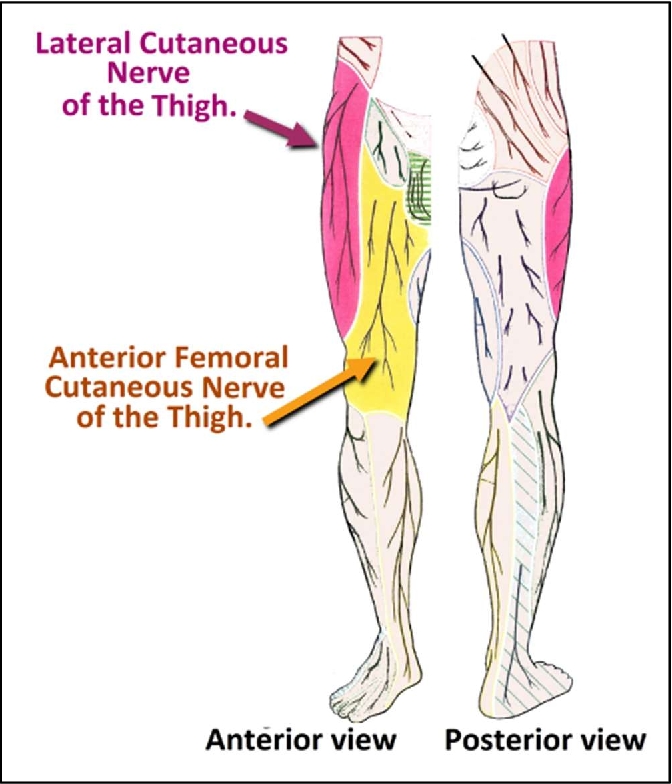
Meralgia Paresthetica (“MP”) is a condition where the territory of the lateral femoral cutaneous nerve (a sensory nerve) feels altered, involving numbness, tingling or other variations from normal sensation. It can occur on both sides of the body, but often is only on one side. There is often a mechanical irritant, such as change in belt or weight that can compress the nerve as it travels under the inguinal ligament and near the bony anterior-superior-iliac-spine (ASIS).
Since MP is rare, there is often a co-existing issue that either renders the nerve vulnerable and/or impedes healing. Superficial nerves, like the skin, are designed to withstand certain extremes of challenge, and to repair effectively when the trauma causes a wound or other damage of a moderate magnitude. Co-existing conditions that can contribute to the development of MP at a “root-cause” level include: unknown diabetes, unknown neuropathy(ies), deficiencies of key nutrients such as Vitamins B1 and B12, and/or toxicity with known neuro-toxins including alcohol, lead (Pb), fluoride, and certain myco-toxins (mold/fungal-based toxins).
Treatment involves identifying the causal factors, nutritional support and proper yoga or other routines geared toward stretch, strength, awareness and balance.